Effect of mining and geology on induced seismicity – A case study
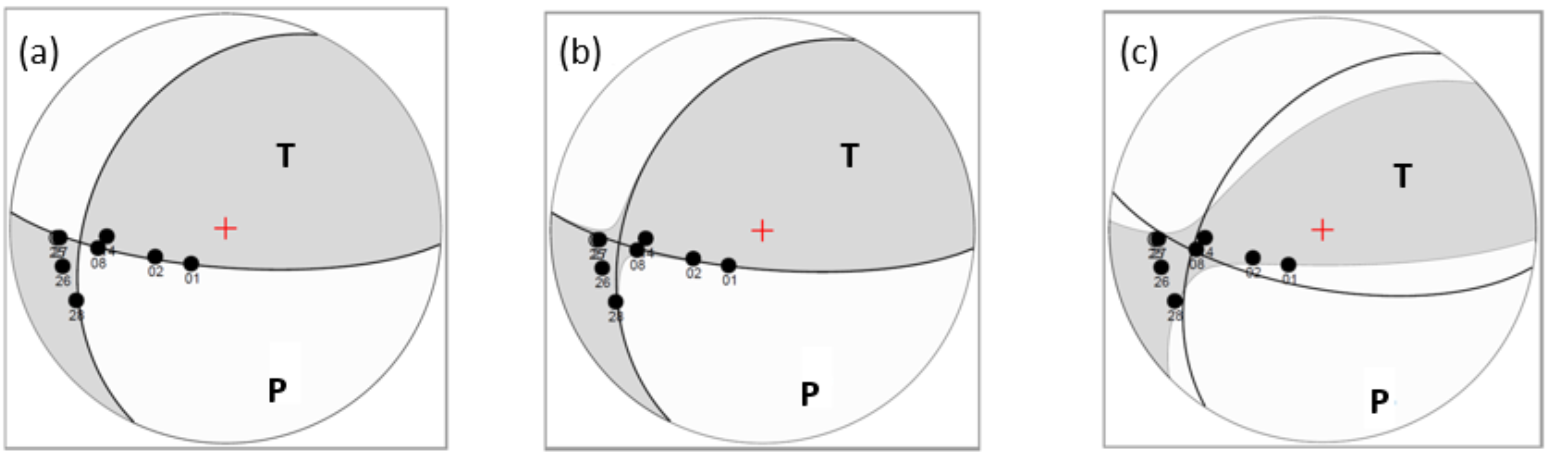
Generated beachballs from focal mechanism solution of the event (1). (a) DC component. (b) Deviatoric component. (c) Full tensor
Sponsor: Alamos Gold Inc., MITACS, NSERC
MSC Thesis by Heba Khalil
High in-situ stresses are expected to induce stronger micro-seismicity as mining production advances to deeper levels. Strong seismic events could cause rockmass and support system damage in drifts and stopes resulting in production delays. Mining-induced seismicity is influenced by a wide range of mining and geology parameters, most notably, stope dimensions, mining sequence, production rate, and geological structures in the vicinity of the work areas. Analyzing the root causes of strong seismic activities can help better understand the influences of such parameters. It could also prove useful for mine planning to mitigate the occurrence of strong seismic events and to provide a safer work environment.
This thesis reports the results of a case study of Young-Davidson (YD) mine of Alamos Gold Inc. in northern Ontario, a gold mining operation using sublevel stoping method. The goal of the research is to conduct a comprehensive study of the microseismic database to discern the root causes of large micro-seismic events. Seismic events of magnitude Mn 2.0+ have been observed at mining depths of only 600 m to 800 m below surface, while strong seismic activities are normally expected to be associated with deep excavations. The occurrence of such large events at shallow depth is the key issue of the first part of the study. Statistical methods are utilized to analyze seismic data and relate it to mining activity. Variation in b-value, derived from the microseismic event magnitude-frequency distribution, is used to identify the rock unstable zones. It is used to differentiate between high and low stress zones and to examine the effect of geological structures, specifically the diabase dykes in the mining area. Furthermore, moment tensor inversion is carried out with MATLAB to analyze micro-seismicity, discern the mechanisms of rock failure.
In the second part of the study, analysis of seismic events of magnitude Mn 2.0+, that were observed in the lower-mine zone, is conducted. Moment tensor inversion of these large events is carried out to identify the rock failure mechanisms using ESG HSS-Advanced seismic analysis software. In-situ stress measurements previously conducted at the YD mine are analyzed and used to generate a 3D numerical model with finite difference software FLAC3D taking into consideration the intersecting dykes. Mine-wide modelling aims to simulate mining-induced stress distribution per the mine plan of primary and secondary stope extraction sequence. Assessment of stress distribution, brittle shear ratio, and strain energy, as well as comparison with seismic source location, magnitude, and mechanism are discussed. Although the findings from this study are specific to the YD mine, they can also be used to elucidate the causes of seismicity in other mines with similar conditions.