Explosive-free breakage of biaxially loaded rock using soundless chemical demolition agents
Sponsor: Natural Resources Canada, Newmont, Ministry of Economics and Innovation of Quebec
PhD Thesis Abstract by Tuo CHEN
The method of drilling and blasting with explosives is widely used in mining and civil engineering projects such as subsurface space construction and mine development and production. Nevertheless, there has been a growing interest in explosive-free rock breakage methods in the last two decades due to the transition to low-carbon economies and green mining in response to climate change. This is because blasting with explosives creates by-products such as hazardous gases, strong ground vibrations, fly rocks, noise, and dust. Soundless Chemical Demolition Agents (SCDA) are one of the alternatives to explosives for rock breakage. SCDA are powdery cementitious products which contain primarily calcium oxide (CaO). Once mixed with water and poured into a borehole in the rock, significant expansion is generated as CaO gradually transforms into portlandite crystals (Ca(OH)2) during the curing process, causing the borehole to fracture under the influence of expansive pressure.
This thesis is part of a multi-phase project focusing on the development of SCDA technique to achieve large-scale hard rock fragmentation in underground mines. More specifically, it involves the investigation of SCDA performance in hard rock environment under biaxial confinement, which is the natural stress condition in a mining front. The thesis begins with a critical review of the history and development of SCDA including its composition, physical properties, fracturing performance, relevant numerical modelling techniques, and current applications in the field. Following the literature review, several numerical models of biaxially loaded panels with different SCDA hole patterns were built and examined with discrete element code PFC2D and finite difference code FLAC3D. Five panel models were analyzed and compared, and the optimum designs were retained for further examination with laboratory testing.
The experimental program was carried out on 1 m x 1m panels made from high strength concrete and Standstead granite. The concrete panels were subjected to constant biaxial stresses of 15 MPa and 23 MPa, whereas the granite panels were subjected to 26 MPa and 40 MPa. Panels were placed in a biaxial loading frame, which was designed and built specifically for this project. The loading frame has a capacity of 10 MN and 6 MN in the vertical and horizontal directions, respectively. All panels are instrumented to monitor applied loads as well as planar and out-of-plane displacements. The concrete tests were repeated on panels from Stanstead granite.
Various SCDA borehole patterns were examined using PFC2D code. Once calibrated against the mechanical properties of the panel material, the PFC model is used to examine and compare different possible borehole patterns in a panel subjected to biaxial stress – a scenario that is analogous to a mining front. The optimum PFC model helped design the borehole pattern for the first concrete panel test with the so-called diamond-shaped hole pattern. In laboratory, such borehole pattern successfully fractured and created craters in the center of concrete and rock panels after 11.8 hours and 3.5 hours, respectively, from the time the SCDA is applied. The relatively short breakage time for the hard rock panel shows the promise of using SCDA as an alternative to explosives in underground mining conditions. In addition, the SCDA induced out-of-plane fractures in the biaxially loaded panel, which is further confirmed and analyzed with FLAC3D modelling. Analysis of the failure mechanism revealed that the concrete panel experienced ductile tensile failure and eventual shear failure, whereas the granite panel only exhibited brittle tensile failure. A second series of large-scale experiments was carried out on two granite panels with V-shape hole pattern, where the drill holes are 45° inclined with respect to the panel face. FLAC3D models show that the V-cut pattern can overcome the biaxial confinement and demolish the hard rock panel. This was further confirmed with laboratory testing on granite. Two panels were observed to collapse after 11 hours 53 minutes and 7 hours 29 minutes, however, these tests used significantly fewer SCDA holes than the diamond pattern. Thus, the V-shape pattern also demonstrates the promise for SCDA as a potential explosive-free rock breakage method.
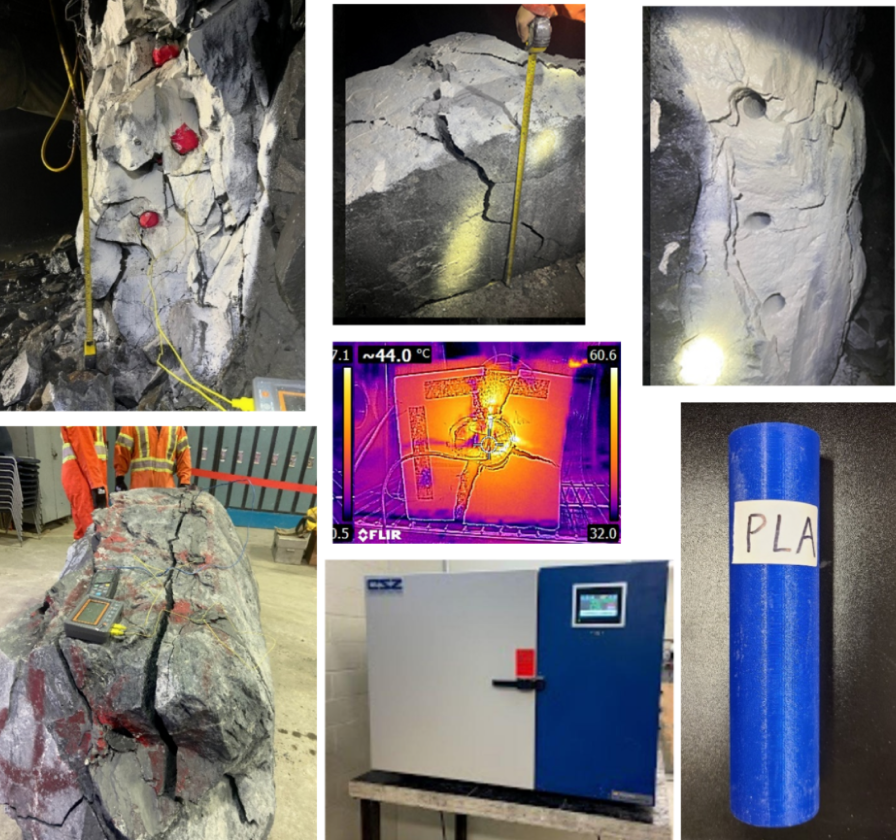
The next step in this research dealt with the method of SCDA slurry loading into a drill hole that is not downhole thus cannot be filled by gravity. A novel method for SCDA loading into horizontal and uptilt holes was developed using 3D-printed cartridges. Four host materials for SCDA, namely thermoplastic polyurethane (TPU), polylactide (PLA), polyethylene terephthalate glycol (PETG), and acrylonitrile butadiene styrene (ABS) are tested in laboratory for rock slab demolition with a single SCDA hole. The best candidate – PLA cartridge – was selected and successfully implemented in a field trial in an underground mine. This method can be utilized for subsurface SCDA applications, where pouring SCDA into a drill hole is not feasible.
Finally, to set the stage for the next phase of this multi-phase project involving in-situ tests, a set of guidelines is proposed to serve as a basis for the implementation of SCDA method in underground mining applications.